Design de Interação, Produção Multimídia, Redes e Mídias Sociais.
688 stories
·
0 followers

5 YouTube Description Templates That Have Helped Our Videos Go Viral

1 Share

YouTube is the second largest search engine, with over 1.8 billion users per month -- so it's an undeniably powerful channel for your marketing efforts.

However, if you don't use YouTube for your current marketing strategy, you're not alone. In fact, only nine percent of U.S. small businesses use YouTube to reach their audience.

In 2018, the HubSpot Academy team didn't take advantage of YouTube, either. But in the latter half of the year, the team feared the major losses in traffic they could face if they didn't hop on board -- so they implemented a strategy that enabled them to grow YouTube subscribers by 25% in just two months.

Ultimately, if you're ready to begin using YouTube to attract and convert an audience, it's critical you optimize your video descriptions for SEO. If you're unsure how to start crafting compelling YouTube descriptions, keep reading -- here, we'll explore various tactics you can employ, and provide templates to ensure you have everything you need to excel on YouTube.

Download a Free 30-Day Planner for Your Business YouTube Channel.

How to Create Compelling YouTube Descriptions

1. Explain what your video is about.

To explore the best tactics for writing YouTube descriptions, I spoke with Eric Peters, a Senior Growth Marketing Manager on HubSpot's Academy team. He told me, "[YouTube descriptions] is one of the primary ways YouTube knows what your video is about. Include links, additional resources, links to other videos and playlists, etc. Make sure the description box is easy to read."

As Peters notes, explaining your YouTube video and incorporating keywords into your description doesn't just help with SEO rankings -- it also helps with accessibility for people who are deaf and hard of hearing. For that reason, adding closed captions to your videos is an absolute must, too.

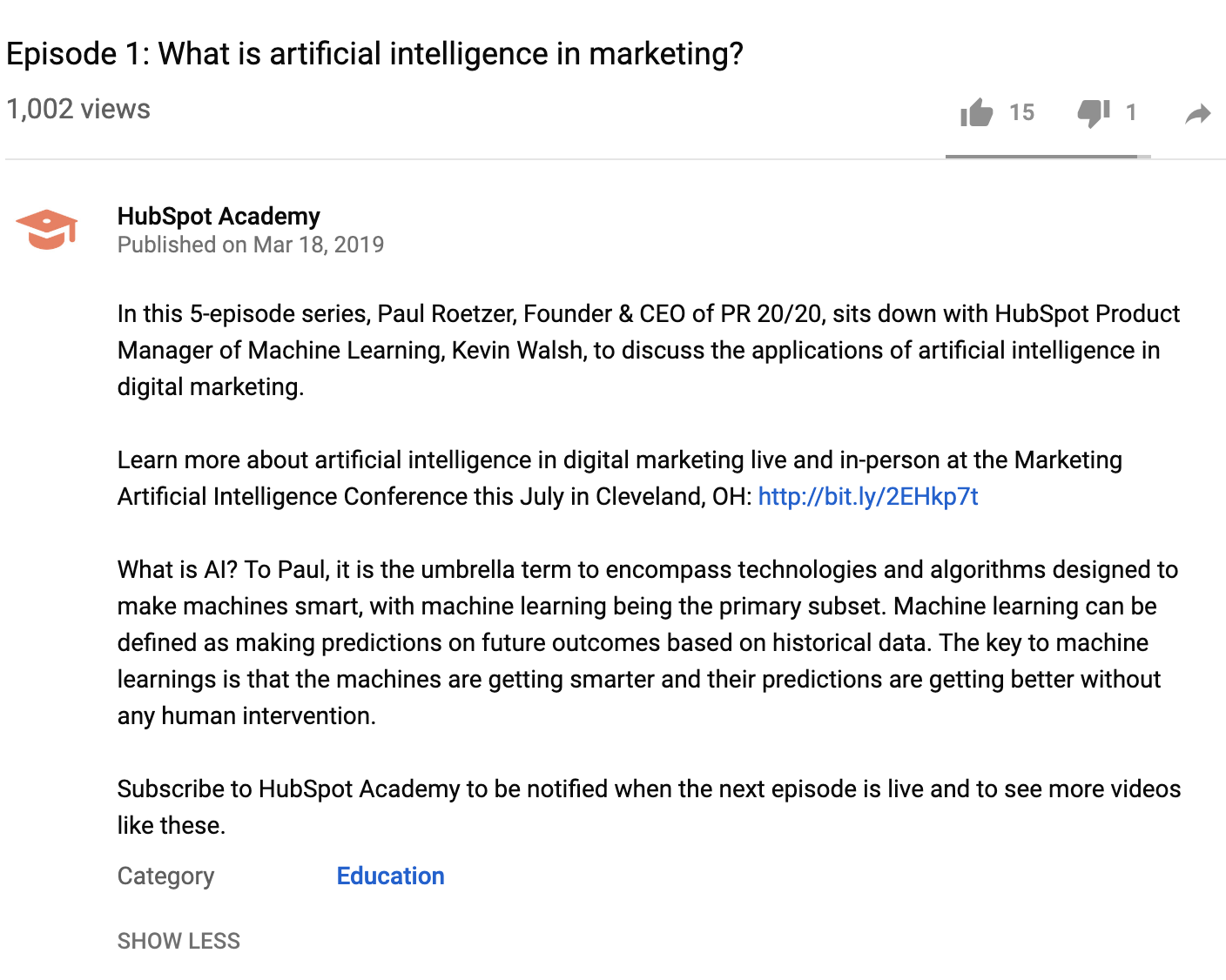
For instance, take a look at one of HubSpot Academy's YouTube video descriptions:

As you can see, a YouTube description is incredibly different from a web page meta description. In a YouTube description, you have the space to go in-depth and explain what your entire video is about, and even link to external resources.

Peters told me, "You get 5,000 characters total, so make use of it. A lot of creators use asterisks or all-caps to differentiate titles from body copy because it's all plain text. Consider writing up a text version of the key points from the video, or even copying the transcription of the video into the description."

2. Include a CTA.

Your YouTube description is a fantastic opportunity to ask viewers to continue to engage with your channel, or find additional resources that will help them learn more about a topic of interest.

For instance, let's say you create a brief "How to add filters to Instagram" YouTube video, but you also have an in-depth, "How to Use Instagram for Marketing" blog post -- why not link to it in the description? More than likely, anyone who is watching your Instagram video on YouTube would be equally grateful for the opportunity to learn more via a blog post.

Alternatively, perhaps you simply want to ask viewers to subscribe, turn on notifications, or share your content with their networks. These are all acceptable CTA's for your description.

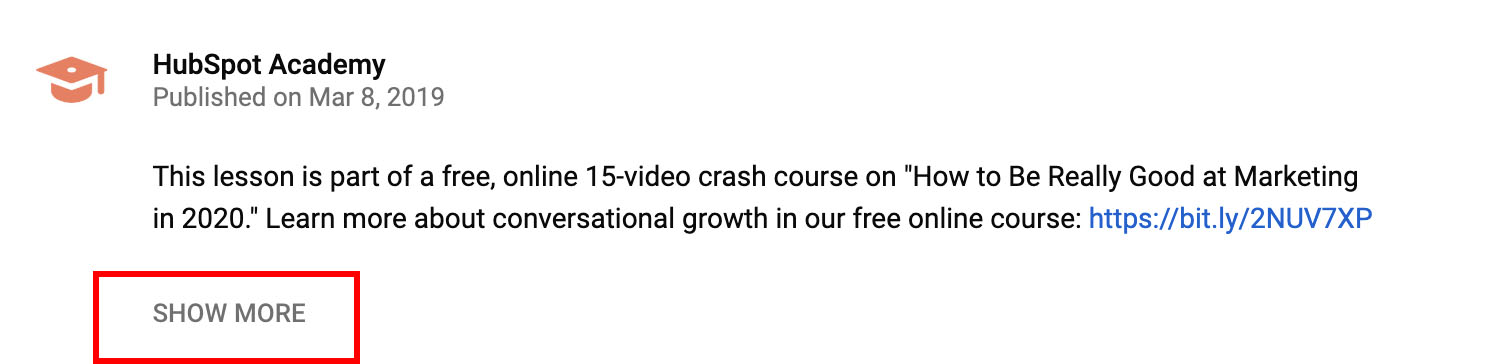
Additionally, it's critical you format your description to ensure you put the most important information first -- as Peters advises, "The first 200 characters are above the 'more' fold on the description box, so if you want your CTA/link to be seen by the most people, keep it within the first 200 characters."

After the first 200 characters, your text will be cut-off, and viewers will need to click "Show more" to see the rest -- so it's vital you make your first 200 characters count.

3. Add your personality.

A YouTube description should be fun, and demonstrate your brand's personality or unique voice to an audience. Unlike more traditional forms of advertising, this is an opportunity for you to instill creativity and humor into your content.

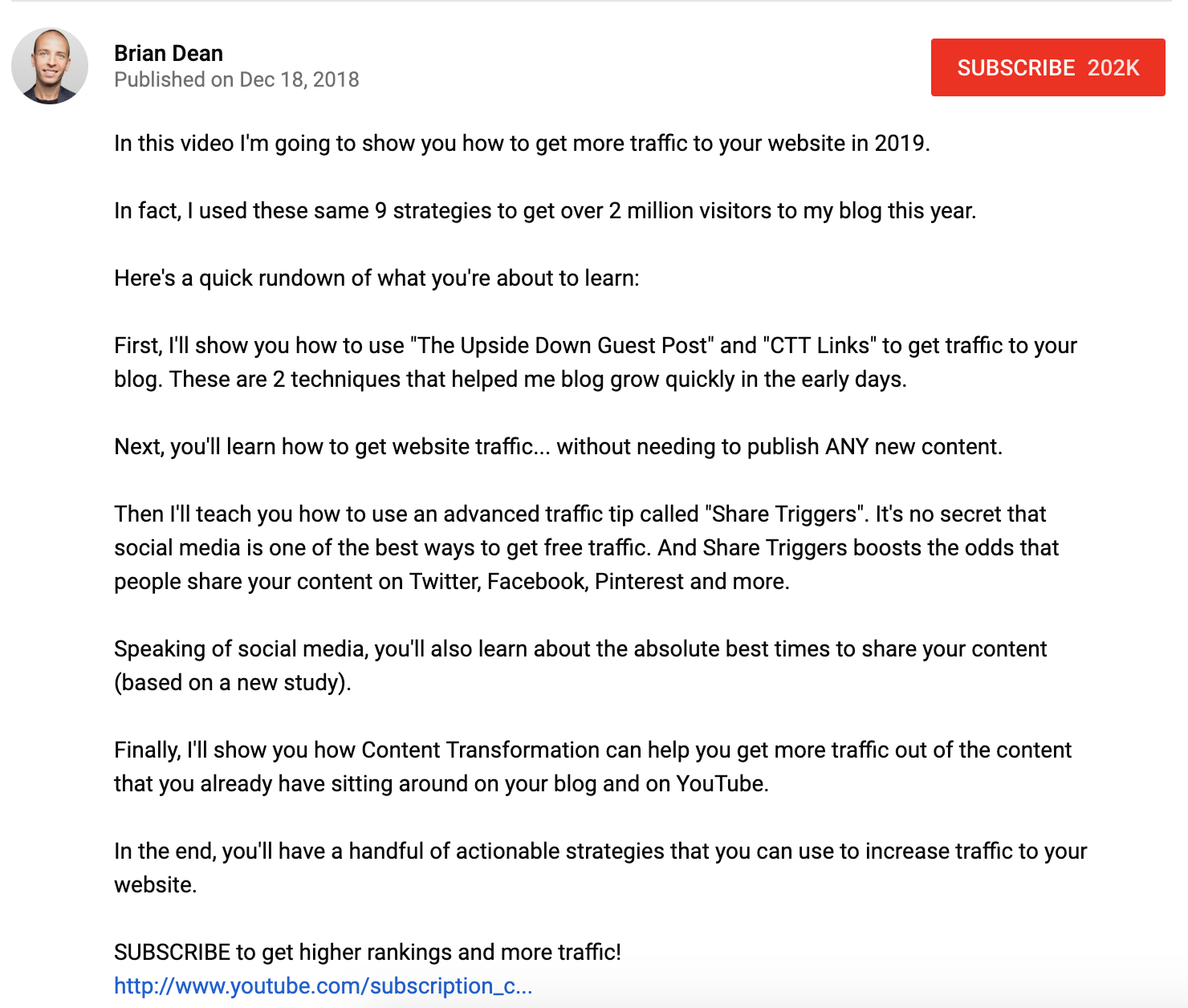
Brian Dean's YouTube channel is a great example of this -- his YouTube descriptions often mirror the way he speaks. The descriptions are candid and casual, and he makes it feel like he's writing to a friend.

To learn more about using YouTube for marketing purposes, consider checking out HubSpot Academy's comprehensive YouTube Marketing course.

YouTube Description Templates

Now that we've covered the basics, take a look at a few templates you can use to craft compelling YouTube descriptions today.

Templates for Your Channel Description

You might create a playful, easy-going channel 'About Me' description, like this one:

Hi, I'm [Name]. This is my channel about X, Y, and Z that you can use to grow your business.

If you're a marketer who wants to learn X to get [result, i.e. more traffic to your site], subscribe to my channel.

My channel publishes videos that focus on X, Y, and Z. If that sounds like it could be helpful for you, please join me!

Alternatively, you can craft a YouTube description that describes what your company does from a third-person point of view, like this one:

Company A is the worldwide leader in X, Y, and Z. Since 2010, Company A has been on a mission to [insert company vision or purpose here].

To learn more about A, B, C, subscribe to our channel to stay informed.

Templates for Your Video Descriptions

If you've conducted an internal interview, you might keep your description short-and-sweet to describe your conversation and why it matters to your audience, as well as a CTA:

Hear how our CEO explains the difference between X and Y, and learn best practices for implementing your own strategy.

Learn more about X and Y in our course: www.XY.com

Alternatively, if you want your description to help new viewers find your various channels, try crafting a description like this one:

Hi there! New to [name of channel]? If so, here's what you need to know -- I like [interests related to channel] a LOT, so I use this channel to explore X, Y, and Z, to help you [desired result for viewer].

Where else you can find me:

INSTAGRAM: http://instagram.com/[accountname]

TWITTER: http://twitter.com/[accountname]

LIFESTYLE CHANNEL: http://www.youtube.com/[accountname]

Join our growing community for new videos every Tuesday and Friday!

BUSINESS INQUIRIES

Please contact [PR representative] at [email or phone number].

Finally, if you want to focus on crafting a description that explains what your video is about and incorporates a keyword description, try this:

Hey there! This lesson is part of a free online course. Take the full course here: www.company.com/course1

Some people are unsure what X is -- at its most basic, X is [brief definition of keyword]. In this video, you'll learn how to X, Y, and Z, to ensure you're able to grow your brand online.

Additionally, we'll explain how you can avoid doing A. Sometimes, A is all it takes to lose a customer.

YouTube for Business
Read the whole story
caiocgo
2605 days ago
reply
Belo Horizonte, Brazil
Share this story
Delete

Apple News Plus is a fine way to read magazines, but a disappointment to anyone wishing for a real boost for the news business

1 Share

Apple announced its much-anticipated premium news service today. It’s called…Apple News Plus? Apple News+? News+ seems to be the official branding (a shift that began in iOS 12.2 beta 4), but the  character doesn’t show up on most non-Apple devices, so let’s go with Apple News+. (Ugh, that “+.” is ugly+. Make it Apple News Plus.) You can watch the keynote here; the Apple News part starts about 6:30 in.

I’m disappointed, I have to say, though that may just be a case of my hopes being too high. Apple News Plus is based on Texture, the Hulu-for-magazines app that Apple bought last year. And “based on” is probably an understatement; it’s pretty much Texture squeezed into the Apple News interface. Texture isn’t bad! I’m a happy paying user, and it does some things well. But Texture’s origin story also limits what this important new product can accomplish. As I predicted last week:

First, let’s go over the basics:

  • Apple News Plus is, like Texture, fundamentally about giving you access to issues of magazines. Not magazine content — magazine issues. Apple says News Plus has 300-plus (or is that 300+?) magazines, but the chances are good that the ones you’ve heard of were already on Texture, which currently lists 204 magazines. (Among the new magazines I could find in Plus: Cricket, Edge, FourFourTwo, All About History, Alta, Babybug, and BBC Gardeners’ World.)
  • The current free content in Apple News will remain unchanged — the same editor-curated stories and packages, the same personalized stories, the same interfaces. Apple News Plus subscribers will get issues and select stories from them highlighted in their main feed and a separate tab that is basically Texture reskinned with the same design aesthetic Apple’s other flagship apps got in iOS 10.
  • In addition to all those magazines, Apple News Plus will include some content from a few non-magazine publishers. In newspapers, that’s The Wall Street Journal and the Los Angeles Times. From the digital natives, that’s three brands from New York magazine (Vulture, The Cut, Grub Street), a new product from Vox (The Highlight), TechCrunch’s subscription product Extra Crunch, and The Skimm. That’s…it, as far as we know. It’s pretty evident that Apple doesn’t consider the newsier part of the package all that critical to the bundle. Based on the timestamps at The Verge’s liveblog, Apple spent a total of 17 minutes and 20 seconds talking about Apple News Plus — and only 1 minute and 10 seconds of that were spent on the non-magazine content.
  • The cost is, just as it was in Texture, $9.99 a month. (Though if you pay with it for the new Apple Card, er, Card, you’ll get 20 cents back!) Apple CEO Tim Cook said that to subscribe to all of these publications individually, you’d have to pay $8,000 a year, so what a deal! Which is mathematically true, but not many people are paying for ABC Soaps in Depth and All About Beer and Birds & Blooms and Canadian Cycling and Cottage Life and Cruising World and Deer & Deer Hunting and Diabetes Self-Management and Family Handyman and Fit Pregnancy and Baby and Gluten-Free Living and Golf Tips and HELLO! Canada and Journal of Alta California and L’actualité and Marlin and Midwest Living and Parents Latina and Popular Woodworking and Salt Water Sportsman and Sport Fishing and Successful Farming and The Pioneer Woman and Truck Trend and Wood and Yoga Journal to begin with. So it’s a difficult comp.

Again, it’s a fine product, just as Texture was a fine product. And obviously, being pitched as an upsell inside an app that 85 million people use monthly will convert a lot more subscriptions than something called “Texture” that the average iPhone user has never heard of. (The most pertinent quote from the whole event was Oprah detailing her reason for wanting to work with Apple on TV projects: “They’re in a billion pockets, y’all. A billion pockets.“)

But there are no companies with greater capacity to do good for both the news industry and the state of news consumption than Apple and Google. They control the operating systems that we spend countless hours staring at and getting information from. When Google decides to show users more news, it works — fast and at scale. When Apple decides to make a News app, it drives a lot of news to people who wouldn’t otherwise have seen it. And because Apple’s customers are the most attractive for news organizations — they on average have more money and consume more news — what they do with paid content matters even more.

Here are my biggest disappointments with today’s announcements.

Apple News Plus is all about magazines, with a heavy dose of lifestyle titles. Nothing against magazines, but it’s supposed to be Apple News.

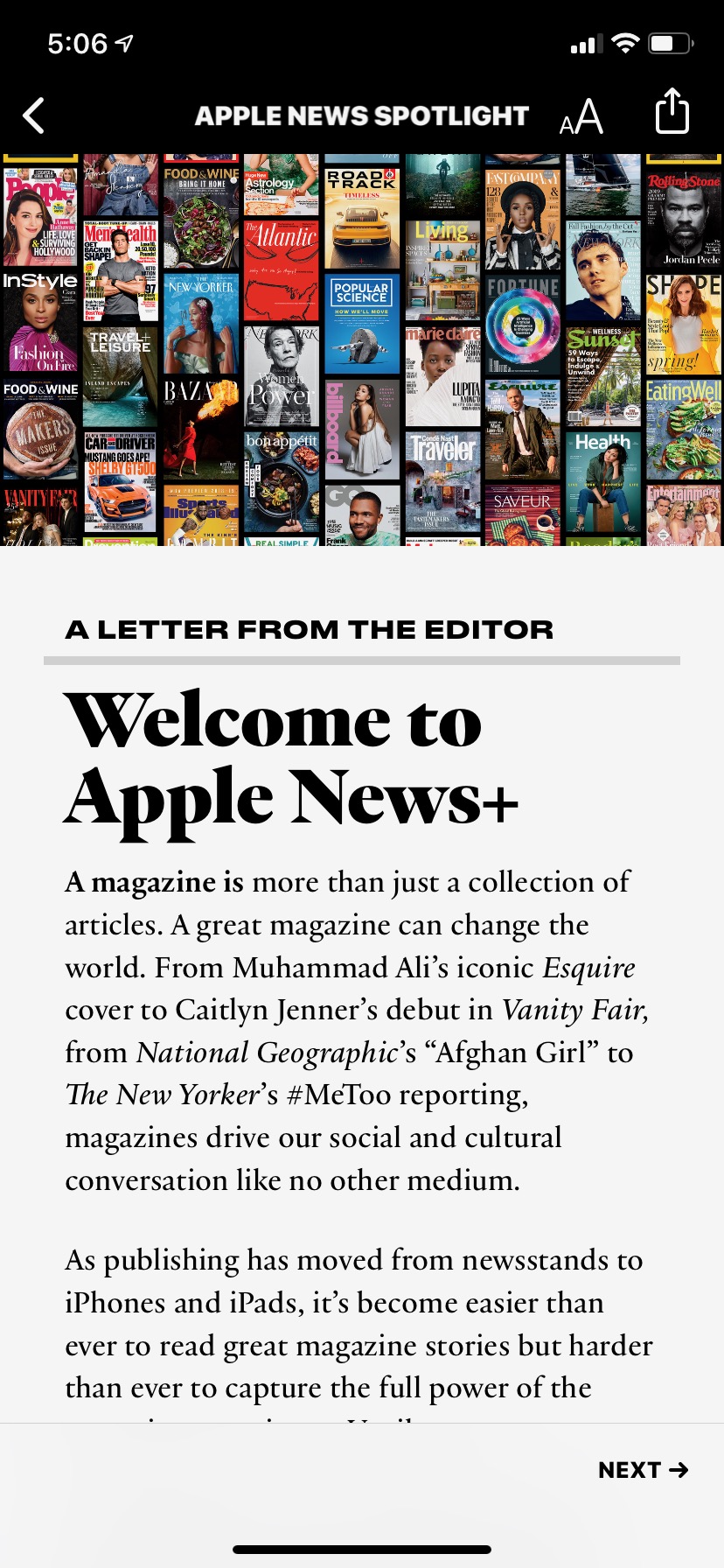
Go watch the keynote and tell me that non-magazine content doesn’t feel shoehorned in. We see zero images of what the digital outlets will actually look like in the app; the newspapers get the barest mention. This is Lauren Kern’s editor’s note for Apple News Plus, which is all about the glory of glossy periodicals:

It’s just a little odd to see The Wall Street Journal (mentioned briefly on the next screen) presented as a side dish. Apple’s marketing presents Plus as having “built-in subscriptions to The Wall Street Journal and the Los Angeles Times,” but doesn’t foreground the fact that you’re only getting a “curated collection of general interest news” from the Journal. (Looking at the L.A. Times in Apple News Plus, it appears to offer pretty much all of its stories.)

It’s actually a little hard to even find L.A. Times and Journal content in Apple News Plus because they don’t fit into the magazine UX it’s dependent on. Tap “Browse the Catalog” in Plus and you can scroll all day, but you’ll never find either paper, because they’re not contained in “issues.” Want to see some Journal stories? Head to the Plus tab, scroll past the nav buttons, past the “My Magazines” carousel, past the “First Look” section, past a curated sports section called “Keeping Score,” and you’ll see four Journal stories. Tap on one of them, then tap on the logo at the top of the article page, and you’re finally at the Journal “built-in subscription” you paid for.

And the L.A. Times? Scroll past everything you saw on your way to the Journal, then a “New Issue” module, then a “Queens of Comedy” feature on Amy Pohler and Maya Rudolph, then a “Health” section, then “Inside Politics,” then “Breakthroughs,” and then you’ll see “From the L.A. Times.” (As I type this, the most recent story listed is 15 hours old.) Tap an article, tap the logo at the top of the article page, and you’re there.

How about the digital offerings — Vox’s The Highlight, New York’s verticals, TechCrunch, and The Skimm? How do you find them? No, seriously, how do you? I’ve looked and I can’t find them anywhere in the Plus tab, which has no search function and whose browse section is, again, limited to magazines. (I did find The Cut under “Style & Beauty,” but there’s no Grub Street under “Food” or Vulture under “Entertainment.” I found Extra Crunch in the non-Plus part of Apple News, but not in Plus.)

I’m not saying all this to complain about the UX, which is something that can be fixed. I’m pointing it out because it shows how tacked-on the non-Texture parts of the app are. It’s a thin and mostly hidden coat of news over what is overwhelmingly a monthly magazine product. Speaking of which…

It’s stuck in the “issue” metaphor.

Texture was built by a consortium of magazine companies (Condé Nast, Hearst, Meredith, Time Inc.), originally under the name Next Issue. It was meant as a way for those magazine giants to make sure that they would be able to control the means of distribution for their products and not let a tech giant like Apple take charge of it.

(So what did that consortium of magazine companies do with the independent distribution platform they’d spent a decade building? They sold it to Apple, of course. Sometimes you just need cash.)

But no matter how much Apple’s aesthetic epigenetics have contributed to Apple News Plus, the underlying magazine industry DNA is very clear — and not to the product’s benefit. Magazine companies produce issues; it’s what they did for many pre-digital decades, and it’s the frame through which they have typically viewed the transition to digital, usually to their detriment.

But even for magazines, only a relatively small share of the work they produce today finds its way into an issue. Take The New Yorker, which produces 47 issues of the magazine each year — but which can publish 47 digital-only stories over just a couple days. (If you want to read those in Apple News Plus, you get thrown out into a web browser, where you get the standard New Yorker paywall. Your “subscription” only goes so far.) Or Vanity Fair, a monthly magazine that has published 22 online-only stories including the word “Mueller” in the last week alone. Magazine companies wanted to sell issues — what unbundled industry has ever enjoyed the unbundling? — so that’s what Apple is hocking today.

It’s a good product on iPads. But how good will it be on iPhones?

Texture was born in a uniquely dumb moment for the news industry — the short window of time, circa 2009-11, when people thought the iPad was going to change everything. Tablets, not phones, had publishers’ attention in that period, much to their later chagrin. Steve Jobs announced the iPad on January 27, 2010, but the magazine industry had been making excited tablet prototypes for some time already; here’s a Sports Illustrated concept video from 2009:

(“I think it’s really, really stupid,” Steve Jobs reportedly said about SI’s prototype, despite the fact it looked a lot like just about every other magazine iPad app since. He might not have meant it.)

Here’s one from the Swedish media house Bonnier (which owns more than 100 magazines, including Popular Science, Field & Stream, Saveur, Motorcyclist, Popular Photography, and the Scandinavian editions of National Geographic):

And though it took another year to launch, there was Rupert Murdoch’s The Daily, the iPad-only tabloid newspaper with “very big” ambitions — and a lifespan of less than two years. (Yes, young people, there was something digital called The Daily before Michael Barbaro.)

If you ever rewatch the documentary Page One: Inside the New York Times (mostly filmed in 2010, released in 2011), there’s an entire section focused on the iPad as journalism’s savior, while smartphones get barely a glancing mention.

Why all the publisher hype around tablets? The reasons were many: It would be a “do-over” of the first round of mobile disruption. That big screen would allow more immersive experiences. It’s hard to remember now, but mobile data was slow 3G garbage back then; “here’s a huge PDF-like thing that you can download at home on your wifi” wasn’t that crazy an idea. And, above all, publishers were already used to producing content formatted into rectangles about the size of a piece of paper. It’s what they did!

It was a bad bet. Tablets have never risen much above 7 or 8 percent of all U.S. web traffic. Meanwhile, phones now generate the majority of web traffic at most American and European news sites.

But it was in this moment of irrational tablet excitement that those magazine publishers joined forces to make what would become Texture. It was initially for tablets only; an iPhone version didn’t arrive until late 2013. And even then, Texture remained completely optimized for tablets — for magazine-sized pages, rendered in PDF, and shrunken to the phone screen in your hand. Some publishers made versions of their “issues” that could look okay on a phone, but most were content to turn the greatest content-consumption device created by mankind into a janky version of Adobe Reader.

I was a skeptic of Texture at first because I had tried it out on my iPhone:

But when I got a nice big iPad Pro a couple of years ago, it clicked for me. Despite a few hiccups, reading magazine issues on a big iPad in Texture is actually a pleasant experience, one I’ve been happy to pay for.

Apple’s presentation today leaned into the idea that Plus would work well on an iPhone (the device most of its demos were done on) and showed off nicely custom article formats. But Texture already has those — just very unevenly. Did Apple convince the publishers of hundreds of magazines to suddenly stop exporting PDFs that are hard to read on phones?

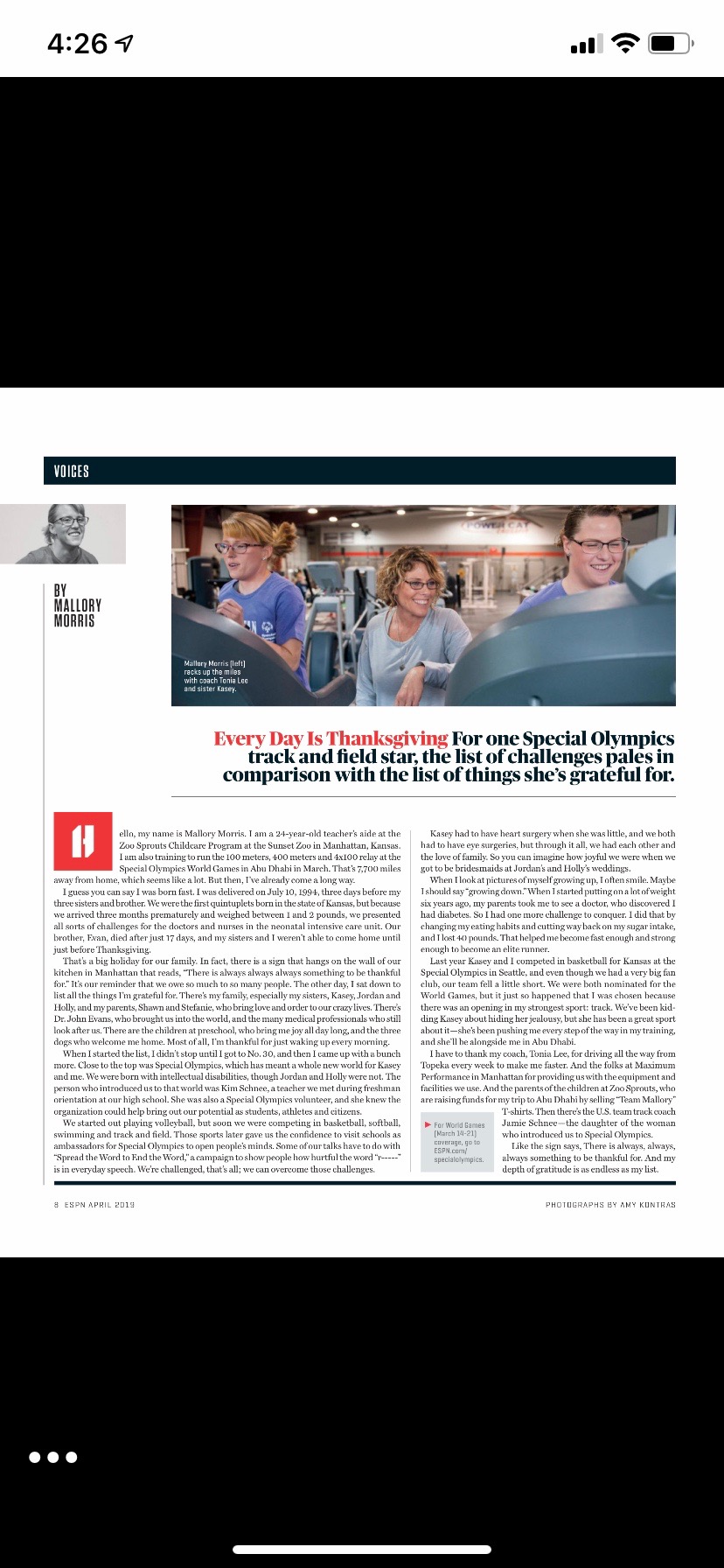
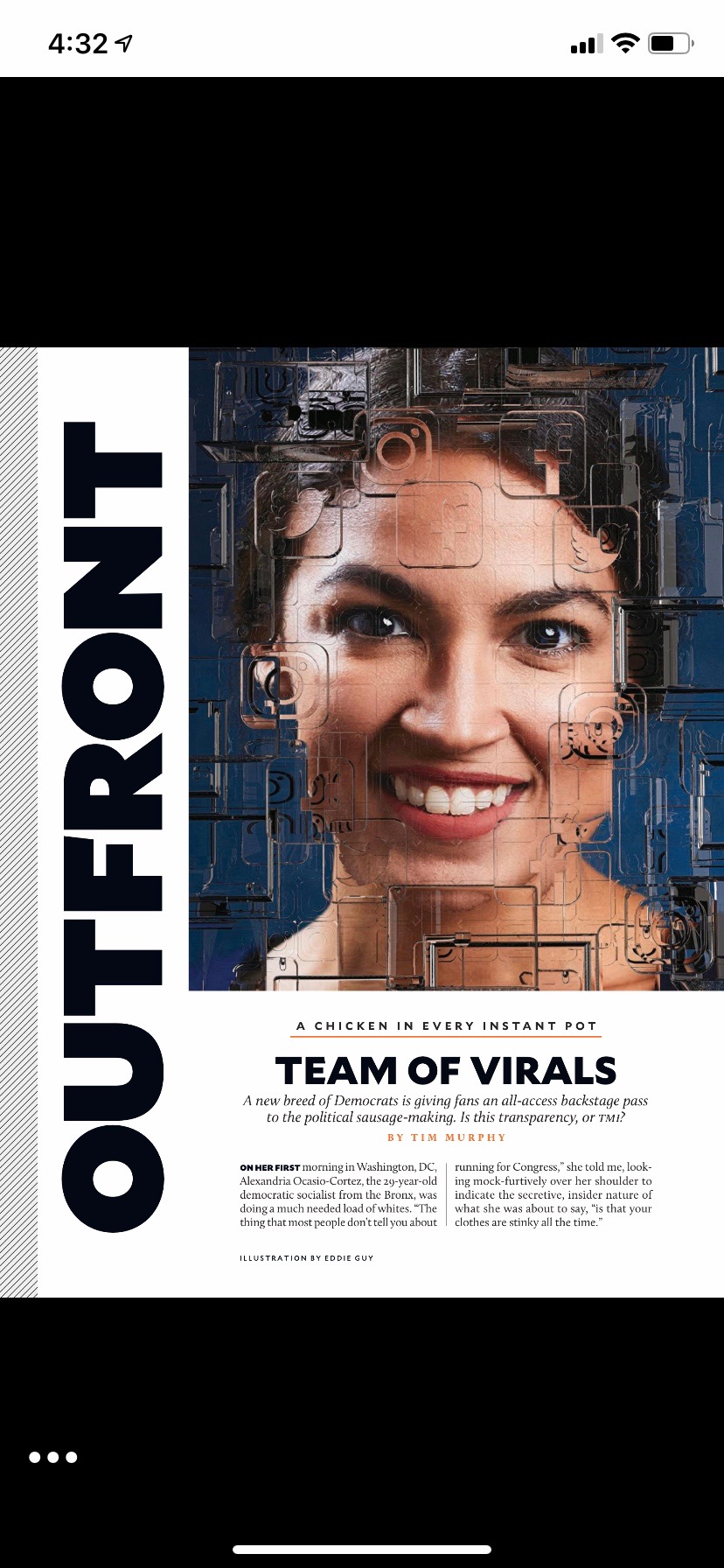
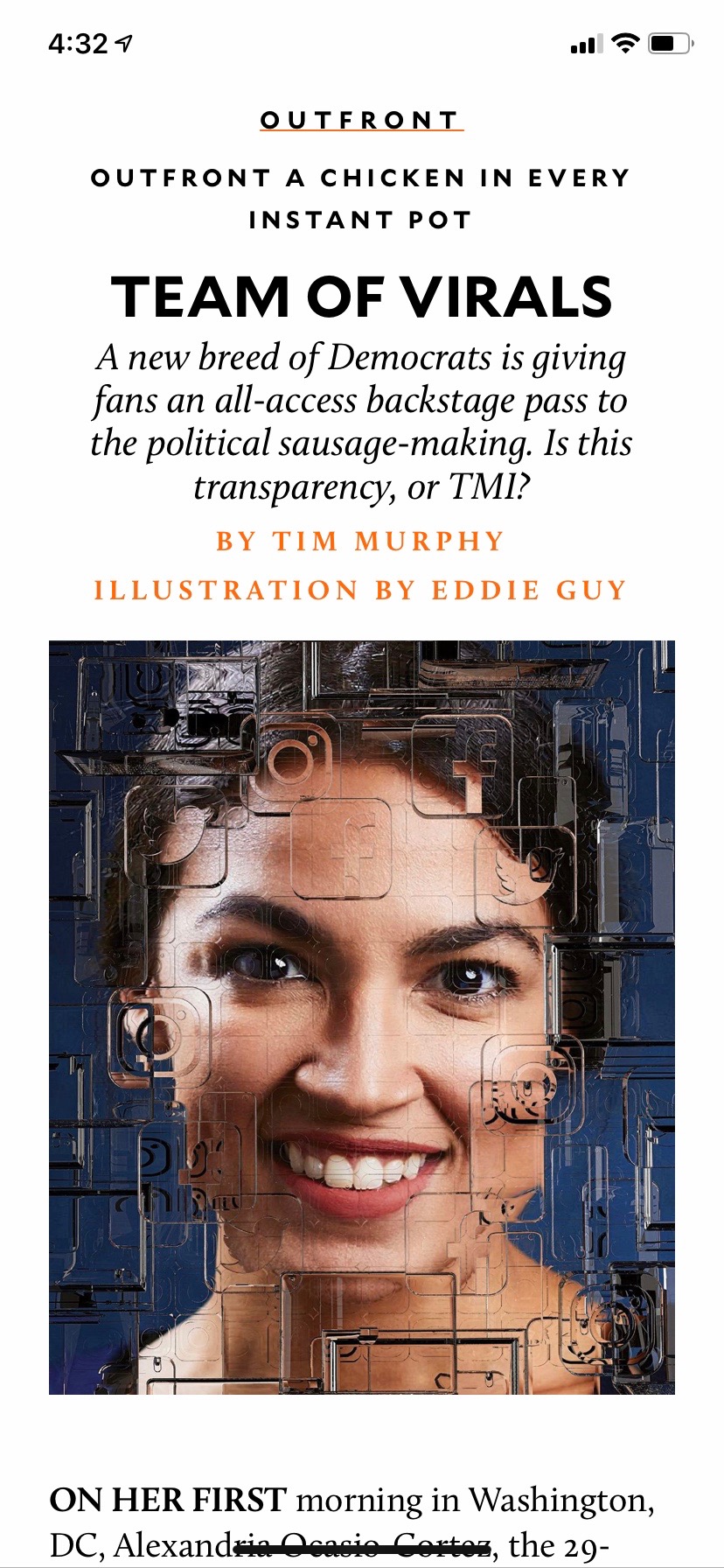
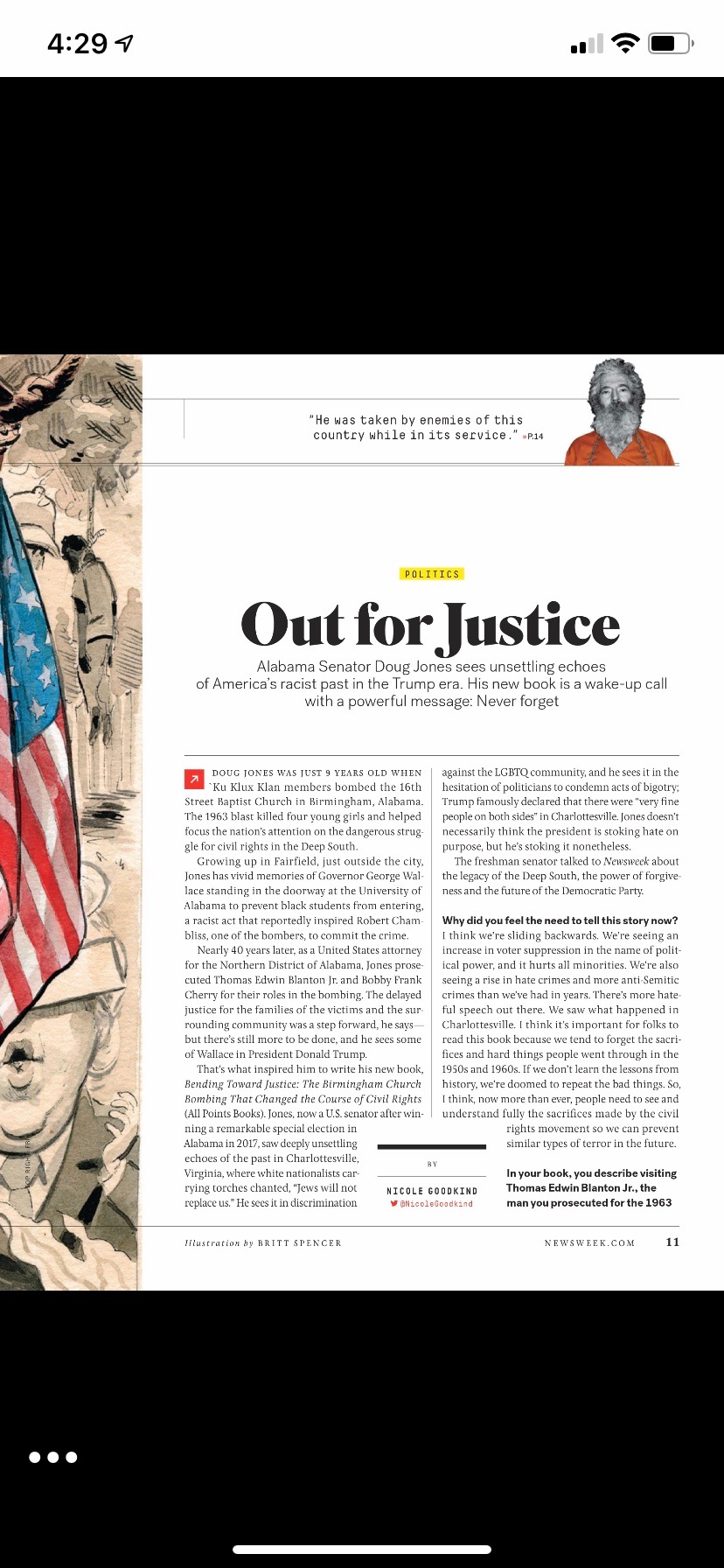
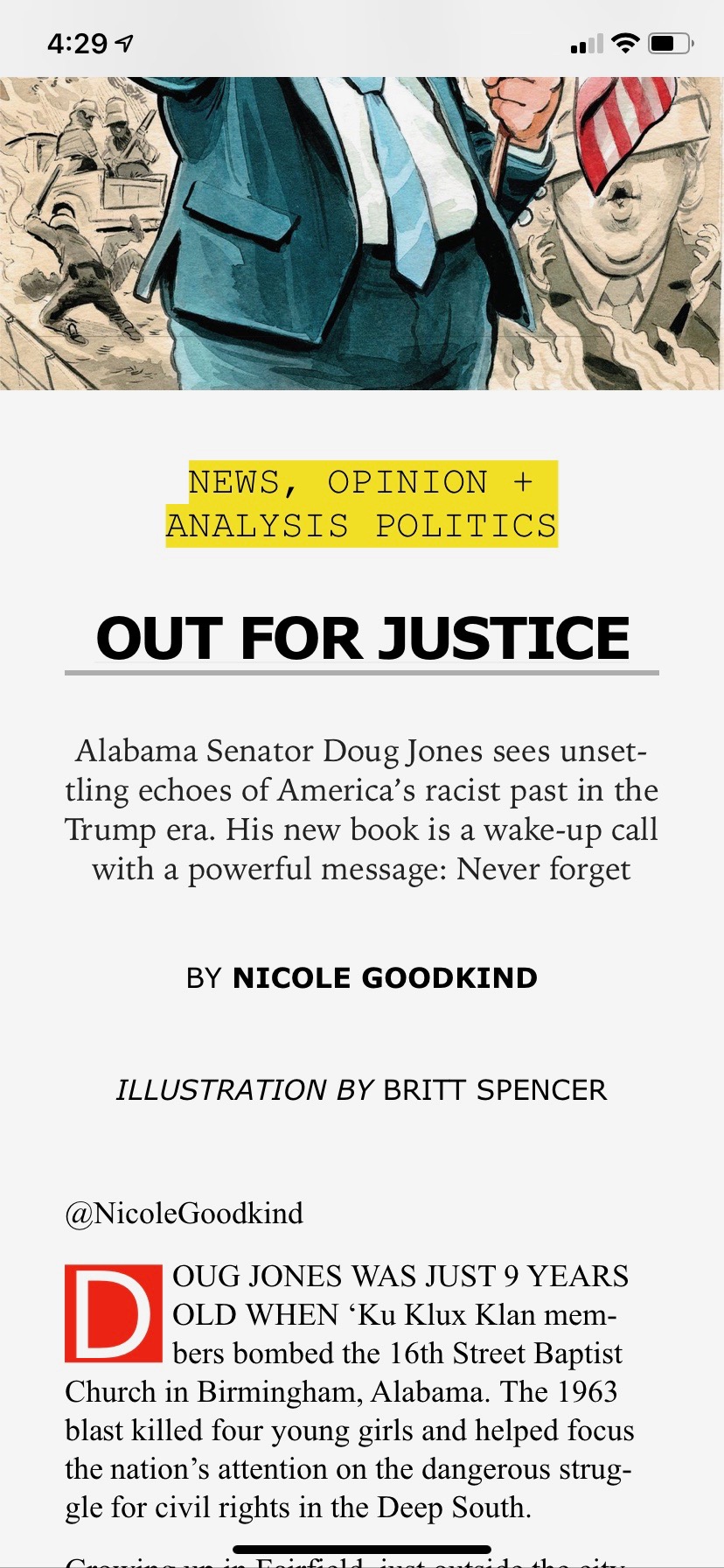
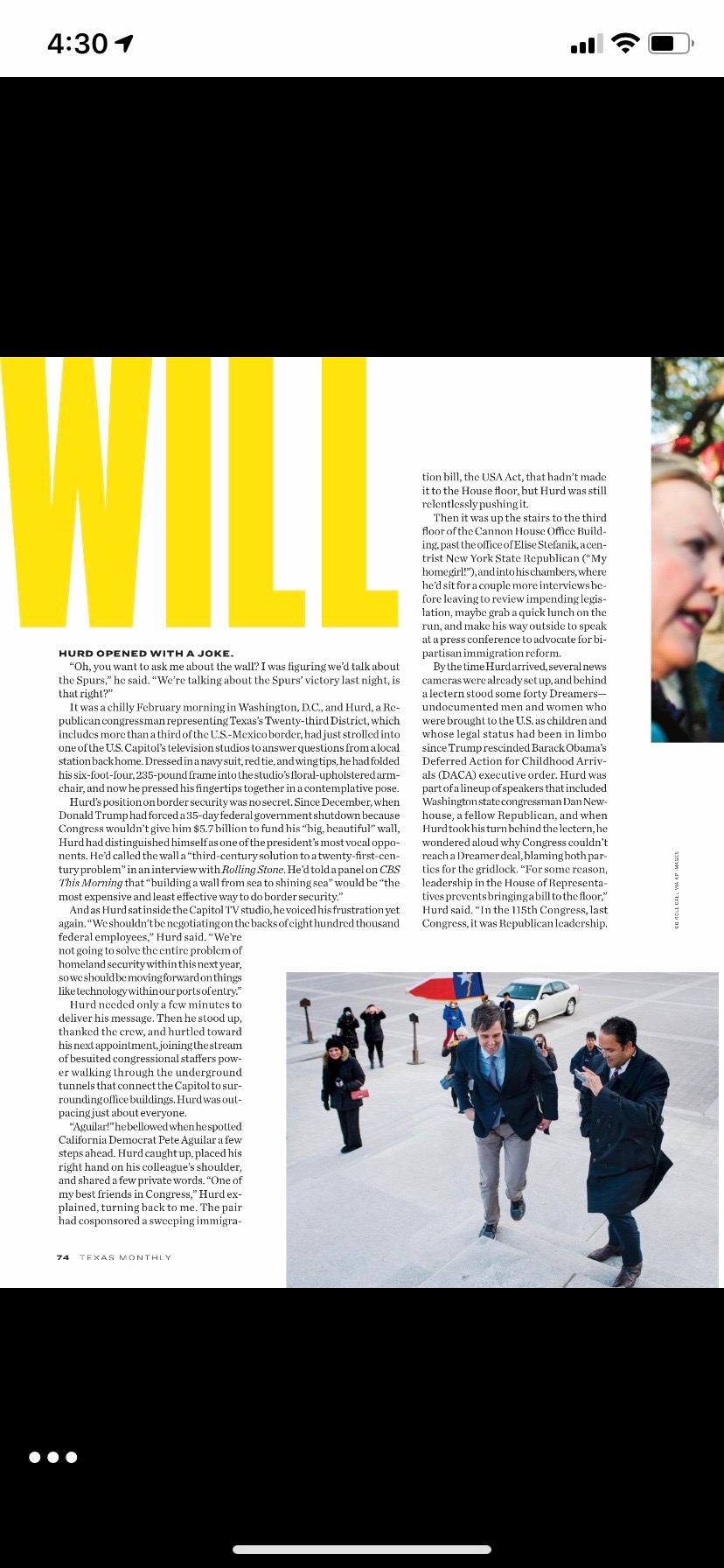
It looks like the answer is, mostly, yes. Comparing the versions of magazine issues that appear in Texture against those in Apple News Plus, there are quite a few magazines that have upgraded to something more readable — it’s perhaps the clearest success in the new offering. A few examples: Here’s Architectural Digest, first how it looks in Texture and then how it looks in the new Apple News Plus.

ESPN the Magazine:

Mother Jones:

Newsweek:

Texas Monthly:

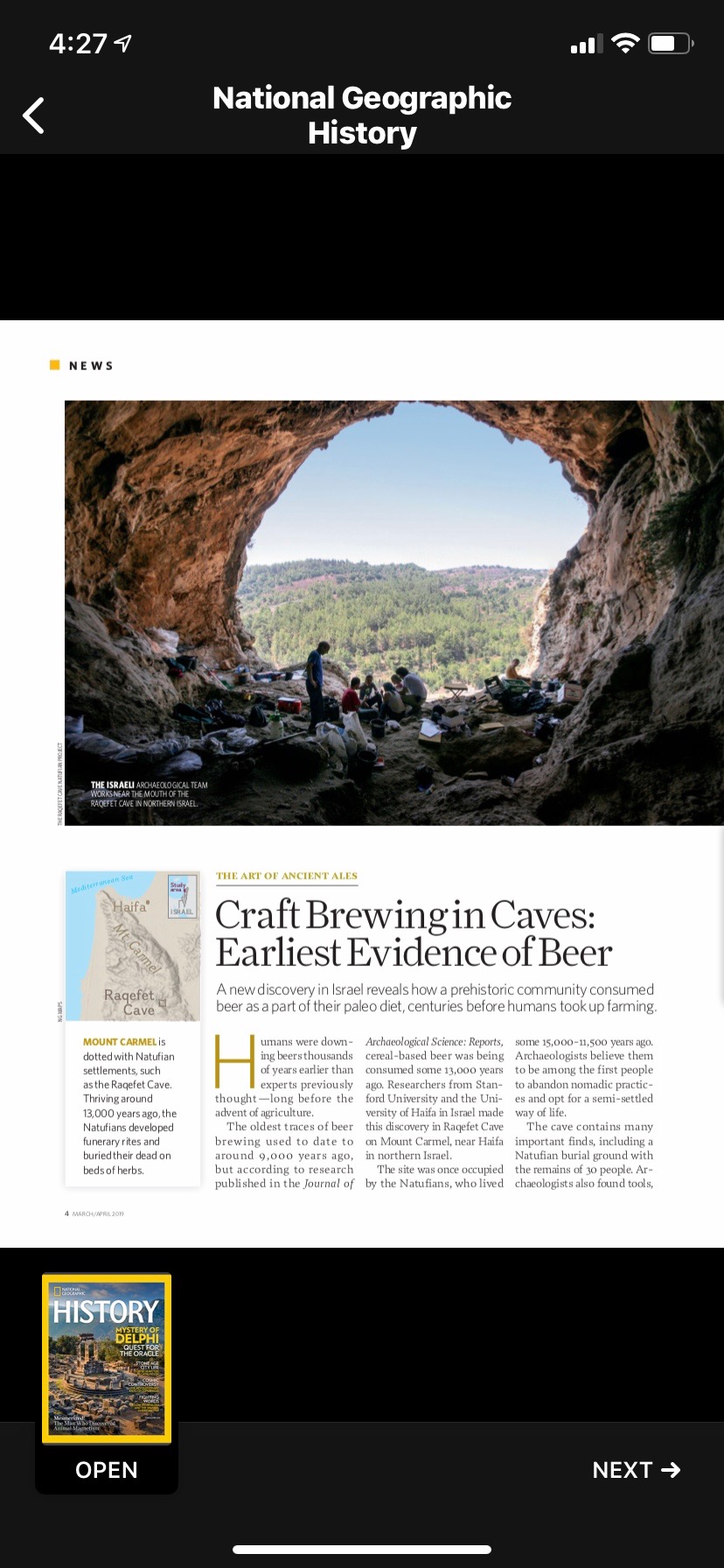
But there are still exceptions, like National Geographic History, which still use ill-sized PDFs:

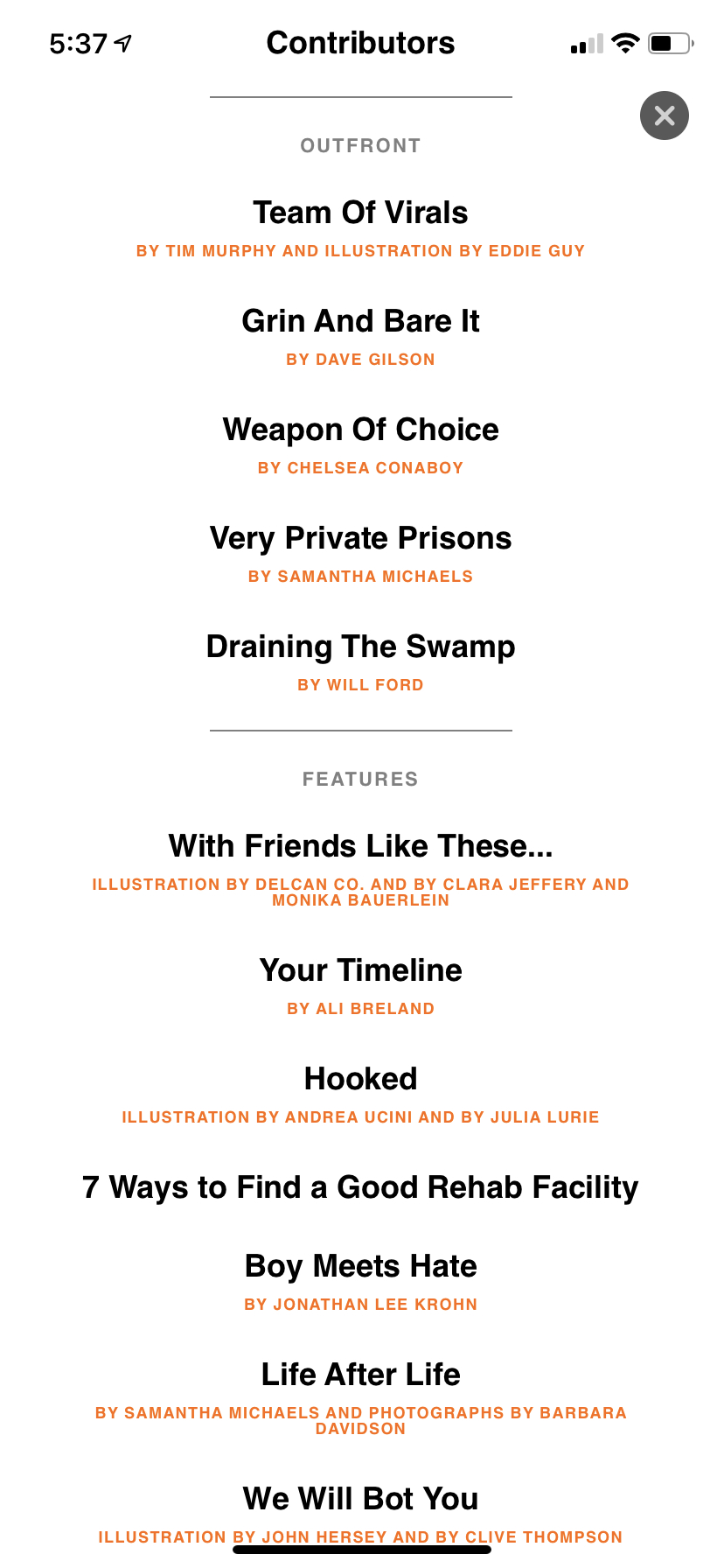
An aside: The presentation still isn’t perfect. For example, an issue’s table of contents seems to use the print edition’s headlines without any context — so a reader looking for an article to read has to guess what topics (in this Mother Jones issue) “Weapon of Choice,” “Your Timeline,” “Grin and Bare It,” and “Hooked” are about.

Will Apple News Plus reduce people’s desire to pay for other digital news subscriptions?

We’ve written before about the extent to which digital news subscriptions seem to be following a power-law pattern: huge success for a few, weak results for many. In newspapers, that’s meant that the Times, the Post, and the Journal have been able to build successful digital subscriber bases in the millions — but that smaller newspapers have struggled to achieve anything like their conversion rates. One question is the degree to which most people — that is, people who aren’t news junkies like most of you reading this article — can be convinced to get more than one digital news subscription. If you’re paying for the Times, will you also pay for The Yourtown Daily? Or is like streaming video, where Netflix and Amazon and Hulu can make lots of money but smaller fry get left out?

Apple News Plus is a paid “news” product in which only a very small share of the money generated will end up supporting the production of daily news, watchdog journalism, or investigative reporting. Apple will keep half of the cash; the rest will be distributed to publishers based on their share of readers’ attention, and the sheer number of magazines makes it likely most of that will go toward the softer side of news. There’s nothing wrong with that. But I suspect some people will think: I pay for Apple News Plus. Why do I need to pay for anything else?

And related to that:

Apple News Plus does nothing for the biggest problem in journalism: the rapid decline of local news.

Unless you happen to live in Los Angeles, Apple News Plus will offer you approximately zero news about your local community. The work that local newspapers do — covering and providing accountability in their towns and cities — is the single most endangered part of our news ecosystem and the part that plays the most important role in our democracy. And this new product likely harms local news on net; I’m sure there will be people who will see the choice as “pay 10 bucks a month for my local daily” vs. “pay 10 bucks a month for 300 magazines” and redirect money that might have otherwise gone into local news.

Perhaps it’s expecting too much of Apple to make even a tiny dent in that problem. Those hundreds of magazines are published by only dozens of companies; they’re easier to deal with than the far more scattered world of local newspapers, and Texture already did that work, anyway. And of course Apple operates on a national and global scale; news out of Kansas City is unlikely to interest a reader in Kalamazoo, much less Kolkata.

But Apple likes to present itself as a force for social good. It wrapped its presentation today in the clothing of important journalism, of civic values, of connecting communities and the world. That its news product finds room for ABC Soaps in Depth but not the Arizona Republic, The Pioneer Woman but not The Philadelphia Inquirer, Family Handyman but not The Flint Journal is not surprising — but it is disappointing.

Read the whole story
caiocgo
2605 days ago
reply
Belo Horizonte, Brazil
Share this story
Delete

In Defense of the Word “User”

1 Share

Recently-ish, there has been a small but noticeable backlash to the word “user”. Yeah, the word for people who do, in fact, use our websites, web apps, and products.

Now, the word isn’t going anywhere, and if you like the word, no one’s saying you must stop using it. I mean, some people are saying that, but you have no obligation to actually do what they say.

So why does it matter? Why would I die on this hill? Because I think this discussion perfectly outlines the fraught relationship our industry has with words and buzzwords. Designers struggle to the complex emotional interactions between human being and interface. Developers struggle to convey math and layers upon layers of abstract-seeming logic. And don’t get me started on what happens when we try to take these concepts and reduce them to job titles…

We change job titles almost as fast as we change JavaScript Frameworks

So what’s going on with “user”? Some people consider the word outdated, which is a fair opinion to have. Some go so far as to call the current use of the word unethical, which I think might be a bit much. Some think it’s not nearly specific enough a word to use in your code, which I think is exactly right.

Now, our language does need to change and evolve with the times. That’s a part of life, and there’s no getting away from it. However at times our industry can get a little too eager to jump from one bandwagon or trend to the next without seriously considering the consequences. We change job titles almost as fast as we change JavaScript Frameworks. We tire of a buzzword, and so we start hunting for a new one, often without seriously asking ourselves these important questions:

  1. Why would we really make this change?
  2. What do we stand to lose?
  3. What do we stand to gain?

Why Would We Really Make This Change?

Taking “user” for an example: arguments against the word range from “it doesn’t reflect the relationship we have with our customers”, to “Saying ‘user’ strips a person of their circumstances…”. Then there was a mention of how the term “drug user” comes with negative connotations, and the insinuation that the negativity of that use of the word could leak into our use of the word.

I’m not going to argue these points individually, because some of them are definitely subjective and personal. If anyone thinks changing the word is going to make them a better designer, there’s no reason they shouldn’t give it a try. Heck, get back to me with the results!

If you think that being called a “user” is inherently a bad thing, maybe the problem isn’t entirely about the word

And if you feel the word doesn’t reflect your values and attitude, that’s fair too. Just don’t make the mistake of changing the word in the hopes of changing people’s attitudes. The great comedian Doug Stanhope made a fantastic point about this:

Basically he noted that back in the day, doctors would refer to developmentally disabled people as “imbeciles” or “morons”, so that’s what Doug and his friends called each other when they did something stupid. People got offended, so doctors started saying “mentally retarded”, so that’s what Doug and his friends started calling each other when they did something stupid. People now get offended at the word “retarded”, so doctors started saying…

You get the idea. If you think that being called a “user” is inherently a bad thing, maybe the problem isn’t entirely about the word. How do you feel about being called a “consumer”? There’s nothing wrong with consuming stuff, and spending money to support the people who made it, but some may find it offensive to be called by that word.

If you change the word without changing the attitude first, if you start calling users your “dear special bestest friends” in the hopes that a change in terminology alone will make for better design, you may be very disappointed. And people might start using “dear special bestest friends” as a low-key insult.

What Do We Stand to Lose?

I contend that to lose the word “user” is to lose a perfectly normal, non-insulting word that is intentionally vague and all-encompassing. Rather than stripping people of their circumstances, I rather feel it includes people regardless of circumstance.

There are certainly times when it’s far too vague, and you might want a term based on the way in which people interact with your site or app. Sure, that’s fine. But we need room for general, catch-all terms when discussing concepts at an abstract level.

I also contend that we’d be losing a well-known, mostly self-explanatory word that can help us quickly impart information to people who are new to the industry. You yourself may have no use for “user”, but it’s a great word for communicating with clients, as well as newbie designers and devs.

Seriously, every time we change the word we use for a single concept, the more confusing talking to designers gets.

What Do We Stand to Gain?

I guess if we ditch the word “user”, there might be an increased focus on specificity. A blog would have “readers”, a store could have “customers”, and so on. Being that specific and accurate all the time could certainly have its benefits.

But then what about those times when we want to be vague?

You could also argue that picking a different word might help to remind us that users aren’t just numbers, that they’re human. A different word might help you better place them in context. But then, if you need to use a different word to help you remember that users are human, with their own circumstances and contexts, perhaps the word being used is the least of your problems.

In The End:

It’s like I said: “user” is (currently) not going anywhere. The point of this article is not to alarm, or to provoke anything but thought. At this point, I think the word is like underlining hyperlinks; were we to suddenly stop, we’d just confuse a whole lot of people to no real benefit.

And yet, there’s nothing to stop you from trying something new, and switching up your vocabulary a bit. I could be wrong, and ditching the word “user” will finally get us all those jetpacks and flying cars. I have my doubts, though.


Featured image via DepositPhotos

Add Realistic Chalk and Sketch Lettering Effects with Sketch’it – only $5!

Source
Read the whole story
caiocgo
2605 days ago
reply
Belo Horizonte, Brazil
Share this story
Delete

How to Stand Out From Content Clutter

1 Share

How to Stand Out From Content Clutter written by John Jantsch read more at Duct Tape Marketing

The internet is filled with a staggering amount of content. A Google search can turn up tens of millions of results for a single query in seconds.

So you’re an expert in your field, and you’re diligently creating content each week. But what is going to give you the edge up on all of the other businesses in your industry? And how will you build a loyal audience who will turn to you, rather than your competitors, for help solving their problems?

Here are some tips to help you create content that is a cut above the rest—work that really stands out from the content clutter.

Find a New Angle

The first step to creating unique content is understanding what makes your brand different. What is your business’s value proposition? You can discover your value proposition by asking yourself why you’re passionate about your work, and by asking your customers why they chose to do business with you over your competitors.

Asking your customers is a critical step, because sometimes the thing that makes you stand out is not what you expected. If you own a coffee shop, you may be passionate about sourcing the best espresso and think that’s what makes you exceptional. But in talking to your customers, you may find that they enjoy your coffee, but are even more excited about the baristas, who go out of their way to learn their names and greet them personally when they enter the store.

Once you understand what gets your customers excited about your business, you can create content that leans into that. Perhaps the owner of that coffee shop would want to start a customer of the month program, where they do a personal feature on one of their customers each month on social media.

Stay True to Your Brand’s Voice

If you’ve ever listened to A-list actors being interviewed about their careers, one of the most common questions they get is, “How did you get your big break?” Often, their answer is that they stayed true to themselves. They were competing against thousands of other actors, but they brought their own voice and personality to the role, and that’s eventually what helped them book the part.

Defining the voice and tone for your brand is a crucial part of creating content that resonates with your audience and keeps them following you rather than your competitor. This can sound like a nebulous pursuit, but you can use the same research you used to find your value proposition to define your voice.

What is it that people like about your brand? Is it your trustworthiness, your friendliness, your authenticity, or your passion? These words can help you create content that fits with the image your customers already have of your business.

Provide Actionable Steps for Your Readers

People turn to the internet looking for content that helps them solve a problem. If your content isn’t useful, it’s going to be ignored. This means you should be providing your readers with clear, actionable steps they can take to fix their problems.

This should be true for all of your brand’s content, from blog posts and webinars to Tweets and Instagram posts. Retweeting memes and cluttering people’s social media feeds with filler content is going to get you unfollowed. Sharing content that is unique, or at the very least thoughtfully curated and re-shared, is what’s going to keep people following your business.

Create Content in Desirable Formats

Part of building an audience for your content is providing content in a format that people want to engage with. Video has become hugely popular, and you should be working to incorporate it on your website and across social media. If you’re creating written content, make sure you’re creating effective copy.

When you’re posting on social media, make sure you’re active on the channels that are most important to your prospects and customers. If your ideal customer is a Baby Boomer, you should probably be focusing your efforts on Facebook rather than churning out content on Snapchat.

Establish Hub Pages to Keep Content Working for You

Creating content is a time-consuming task. And when you’re creating great content, you want to be sure you’re squeezing every ounce of value out of it. That’s where hub pages come in. These pages allow you to group your similar content together, making it easy for your audience to do a deep-dive into their topic of interest.

This positions you to be regarded as a thought leader in that area, allows you to continue to generate views for older content that would otherwise fade into the archives on your blog, and strengthen your ranking on search engines.

When you think about content creation, it can be easy to feel defeated: “There are so many other people out there on the internet, providing insight in my industry—how can I possibly stand out?” Fortunately for you, a lot of the content out there is not good. It doesn’t have a strong identity, and it doesn’t really add much value for readers. If you can create content that’s meaningful for your audience, you can get the upper hand and rise to the top of the content heap.

Read the whole story
caiocgo
2626 days ago
reply
Belo Horizonte, Brazil
Share this story
Delete

Como a internet está matando a democracia

1 Share

Publicado originalmente por Agência Pública.

Por Ethel Rudnitzki.

“Fomos muito ingênuos”, adverte o pesquisador e jornalista inglês Jamie Bartlett. Para ele, nos primórdios da internet “havia uma ampla visão de que o simples fato de tornar a informação mais disponível e permitir que todos pudessem criar e compartilhar informação transformaria o nosso ambiente em mais informado, politizado e racional.”

Não foi o que aconteceu, e segundo ele a radicalização atual nem era tão difícil de prever. Para Bartlett, os grupos radicais chegaram antes à internet por estarem fora dos jornais e do mainstream. “Mas o mais importante é que todos nós nos tornamos mais radicais”, explica. “Pulamos de um assunto para outro e somos apresentados a mais e mais conteúdos apelativos e sensacionalistas para manter nosso vício nas redes.” Como resultado, somos expostos a argumentos emocionais radicais e acabamos xingando e vociferando nas redes sociais.

Autor do recém-lançado livro The people vs tech: How the internet is killing democracy and how we save it (O povo vs tecnologia: como a internet está matando a democracia – e como podemos salvá-la, em tradução livre), ainda inédito no Brasil, Bartlett faz parte da Demos, um think tank britânico que reúne especialistas em educação e tecnologia para pesquisar temas relacionados à política.

Em entrevista à Pública, Bartlett fala sobre a radicalização promovida pelo ambiente online, desinformação, campanhas digitais e outros perigos da rede para a democracia.

Mas, mais do que constatar os problemas, o pesquisador propõe soluções para avançarmos junto com a tecnologia. Entre elas, um departamento governamental dedicado a fazer uma auditoria de algoritmos e uma base de dados pública, com registros instantâneos, de toda propaganda eleitoral publicada nas redes. Leia a entrevista a seguir:

O surgimento da internet, e depois das redes sociais, veio com a expectativa de uma maior democratização da informação e do debate público. Ao longo do tempo, essa ideia desapareceu. Pesquisadores, incluindo você, mostram que, ao contrário de democratizar, o ambiente virtual potencializou discursos radicais e extremistas. Por que isso aconteceu?

A primeira coisa que precisamos entender é por que fomos tão ingênuos no início. Havia uma ampla visão de que o simples fato de tornar a informação mais disponível e permitir que todos pudessem criar e compartilhar informação transformaria o nosso ambiente em mais informado, politizado e racional. Eu penso que boa parte da razão para essa crença veio do fato de que a maioria das pessoas por trás dessa tecnologia são pessoas da costa oeste dos Estados Unidos, da Califórnia. Pessoas extremamente liberais e grandes defensoras dos poderes naturais da livre informação e alienados das reais questões do mundo. E isso é só uma das explicações. Foi uma ingenuidade criar essas expectativas. As pessoas assumiram que a internet e as redes sociais seriam extremamente livres e que não haveria controle sobre as informações que estariam ali. Ninguém pensou nas consequências.

Jamie Bartlett é autor do livro “O povo vs tecnologia: como a internet está matando a democracia – e como podemos salvá-la”, em tradução livre. (Foto: Arquivo pessoal)

Mas, olhando com mais atenção, era possível ver que não seria bem assim. Na maioria das novas tecnologias, são as pessoas mais radicais, marginais e até criminosos que primeiro aprendem suas possibilidades. Eles têm essa vantagem, pois, na maioria das vezes, os mais autoritários se consideram excluídos, então dedicam boa parte de sua vida a novas técnicas e tecnologias.

O que eu descobri foi que, se você observar grupos de extrema direita, e até alguns grupos radicais de esquerda, na maioria das democracias, são eles os primeiros usuários de novas tecnologias. Neonazistas, por exemplo, encontraram maneiras de usar as redes sociais para espalhar suas mensagens, porque eles são determinados e não tinham outra forma de fazer isso. Se você os tira da mídia tradicional, é natural que eles procurem outros meios.

Adicione a isso o fato de que em troca da gratuidade das redes sociais nós damos a elas [as empresas de tecnologia] nossos dados. Assim elas tornam essas plataformas ambientes viciantes, para que fiquemos mais tempo lá, fornecendo ainda mais dados. E nossa tendência é clicar naquilo que for mais extremo, radical, inacreditável, pessoal.

Isso deixou as pessoas mais radicais, ou foram os extremistas que se tornaram mais fortes?

Boa pergunta. Eu acho que os radicais cresceram nas plataformas digitais porque tinham essa vantagem de serem usuários há mais tempo. Mas o mais importante é que todos nós nos tornamos mais radicais – não exatamente extremistas, mas somos exponencialmente expostos a conteúdos radicais e apelativos. Não temos a intenção de falar sobre essas temáticas, mas elas nos são apresentadas. Assim, quando entramos nessas plataformas, gritamos uns com os outros, discutimos sobre coisas pequenas, discordamos sem ao menos escutar o outro lado. Pulamos de um assunto para outro e somos apresentados a mais e mais conteúdos apelativos e sensacionalistas para manter nosso vício nas redes. E o resultado é que nos tornamos mais extremos.

E como Trump, nos EUA, e Bolsonaro no Brasil se beneficiaram desse ambiente polarizado?

Na minha opinião, esses políticos se baseiam em frases de efeito e soluções simplistas. E é exatamente isso que funciona nas plataformas de redes sociais. Discursos populistas sempre foram apelativos. Sempre se trata de apelar para o emocional, tratar problemas complexos com soluções fáceis.

As redes sociais são excelentes ambientes para amplificar essas mensagens porque não são tratadas como nos jornais, por exemplo. Com as notícias, temos que nos sentar e pensar sobre o que lemos. Não somos guiados por emoções. Mas nessas plataformas, sim. Quando compartilhamos conteúdos, esperamos respostas, curtidas, então é mais provável que publiquemos conteúdos que nos fazem sentir raiva ou animação do que conteúdos profundos e reflexivos.

Você acredita que essa radicalização impulsionada pelas redes é igual para a direita e para a esquerda?

É uma pergunta muito difícil de responder. Eu acredito que o discurso político que funciona nas redes pode ser tanto de direita quanto de esquerda.

Qual é o papel da desinformação nesse processo de radicalização online?

O problema não é a desinformação em si, mas o fato de haver diversas categorias de notícias falsas nas redes, e todas elas causam um efeito importante.

Na internet você acha todo e qualquer tipo de informação, verdadeira ou falsa. Há aquelas postadas por veículos de notícias e as que são apenas histórias de pessoas e também podem ser confiáveis. E há aquelas que são ruins e mentirosas. Ninguém sabe qual é verdadeira e qual é falsa. Então, no que as pessoas confiam quando não sabem no que acreditar é simplesmente em suas próprias intuições e emoções. Você confia no personagem que você acha que combina mais com você e fala coisas que você acredita. E isso é mais um elemento que beneficia os populistas porque eles geralmente são melhores em convencer as pessoas.

Não é simplesmente a desinformação pela desinformação, é que a informação circula em bolhas. Na rede você encontra dados e estatísticas para embasar qualquer opinião que você tenha. Cada um tem seus próprios fatos. E eles não estão exatamente certos, mas na internet é possível encontrar tanta coisa que existe informação para o que você quiser, tudo que valide sua opinião.

E estar envolvido em tanta informação assim é mais preocupante que as próprias notícias falsas. Por que é isso que faz com que as pessoas não saibam no que acreditar e parem de prestar atenção nos jornais para guiarem-se apenas pelos sentimentos. E é também isso que está tornando os políticos mais radicais, porque ninguém mais tem a autoridade sobre a verdade ou sobre os fatos.

No seu livro, você fala muito sobre o disparo de mensagens na campanha de Donald Trump com a ajuda de dados fornecidos pela empresa Cambridge Analytica. Você pode explicar como essa empresa ajudou Donald Trump, que não era do meio político, a ganhar as eleições nos EUA?

A tecnologia usada não era única ou inovadora, e vem sendo usada por publicitários há muito tempo. Eles basicamente identificaram pessoas que acreditavam que eram mais suscetíveis de serem convencidas pela campanha. O que eles fizeram foi construir perfis detalhados de milhões de americanos usando dados disponibilizados publicamente na internet. Esses dados, que podem ser comprados, incluem coisas como o valor da sua casa, que carro você tem, que revistas assina e muito mais. Eles pegaram o máximo de informações das pessoas que conseguiram e dividiram elas em grupos, enviando conteúdo mais provável de convencê-las.

Além de eleições, essa tecnologia pode influenciar outros aspectos da nossa vida. Somos bombardeados com anúncios personalizados, é como se as empresas soubessem mais de nós que nós mesmos. Como isso afeta a democracia?

Para mim, o maior problema é a popularização dessas técnicas de publicidade com dados, especialmente quando não há regulação. Significa que qualquer um pode dizer que seu opositor está trapaceando.

Qualquer um que perder uma eleição pode dizer que o adversário está usando dados de pessoas indiscriminadamente e manipulando eleitores com publicidade. E isso compromete a integridade de qualquer pleito. Quando você usa essas técnicas, na cabeça das pessoas, isso compromete a integridade de uma eleição.

Você não acha que a popularização dessas técnicas de publicidade vai fazer as pessoas questionarem suas escolhas e atitudes online?

É o seguinte: ninguém acha que foi influenciado por um anúncio. Nunca. As pessoas sempre falam: “Ai, isso não me afeta”. Mas, então, por que os publicitários investem tanto nas redes sociais? Por que eles já testaram e viram que realmente funciona.

Uma das razões pelas quais eu escrevi meu último livro foi para tornar as pessoas mais conscientes da maneira como seus dados estão sendo usados. E eu acho que as pessoas estão cada vez mais preocupadas.

Você vê um crescimento em outras formas de usar a internet?

Sim, eu vejo. Acho que está crescendo e melhorando. No Reino Unido, nós temos VPN [redes privadas individuais], que nos dá mais proteção de dados, e significa que empresas só conseguirão coletar nossos dados se dermos autorização, e isso nos dá o direito de pedir nossos dados de volta também. Já existem empresas que ajudam as pessoas a recuperar seus dados de outras empresas, novas redes sociais estão surgindo. Então, existem pequenas iniciativas nesse sentido. Eu não sei se vai funcionar, ou se vai fazer muita diferença, mas eu vejo melhora.

Existem maneiras de minimizar os efeitos dessa falta de privacidade online sem ser pela via completamente anônima e criptografada. No seu livro, uma das soluções que você sugere é o policiamento dos algoritmos. Você pode explicar como isso funcionaria?

Sim. O que podemos fazer é criar formas de controle democrático sobre os sistemas que possuem nossos dados pessoais. Uma das maneiras de fazer isso é da mesma maneira que fiscalizamos nossas instituições como escolas, serviços de saúde etc., para garantir que eles estejam funcionando. Com os algoritmos isso não é feito. Ninguém sabe se certos tipos de notícias estão sendo privilegiados pelos algoritmos, por exemplo. Eu não tenho a exata solução para isso, mas eu acho que é preciso criar um sistema de fiscalização.

A lógica é: se há um poder, é preciso criar um sistema de fiscalização.

Sim, mas isso precisaria ser feito pelo poder público, e os políticos que temos atualmente mostram muito pouco conhecimento sobre as questões do ambiente digital. Prova disso foi a audiência realizada com Mark Zuckerberg no Congresso americano. Você acha que essa equipe é capaz de formular políticas públicas eficientes nesse sentido?

Eu acho que é possível. Não é preciso ser um engenheiro de computação para pensar em soluções para esses problemas digitais. Eu só acho que é preciso disposição e investimento. Por que não seria possível instalar um departamento para fiscalizar algoritmos? Para mim parece possível e plausível, apesar das dificuldades.

Mas os problemas que temos são urgentes. Como cidadãos, o que podemos fazer?

O que eu mais tenho dito é que precisamos olhar nosso comportamento online como um passo. Eu acredito que temos o dever, como cidadãos, mais importante do que votar, de refletir sobre nosso comportamento online. Que dados estamos criando? Com quem estamos compartilhando? Que plataformas estamos usando?

Porque, toda vez que compartilhamos nossos dados, estamos contribuindo para a sociedade de controle que vivemos atualmente.

E as plataformas? Você acha que elas devem ser mais bem reguladas? De que maneira?

Sim. Eu acho que há regulações que podemos criar. A mais fácil delas seria definir essas empresas como publicitárias e investigá-las para combater oligopólios e promover a livre concorrência. Não pensá-las como plataformas de redes sociais.

Temos que ficar atentos às aquisições que essas empresas fazem, porque muitas vezes elas compram plataformas menores antes mesmo que estas se tornem competitivas. Então, temos que bloquear esse tipo de compra.

E há algumas outras coisas, como regular o conteúdo que circula nesses lugares, como o discurso de ódio. E multá-las caso não removam esses conteúdos.

Que outras medidas legais precisam ser tomadas na sua opinião?

Devemos atualizar as legislações eleitorais urgentemente, porque elas estão ultrapassadas. Uma das coisas que eu proponho é que todos os anúncios usados em campanhas eleitorais devem ser publicados em tempo real num banco de dados público para todos verem. Eu acho uma medida importante e fácil de ser implementada. Acho que isso pode aumentar a confiabilidade das eleições.

E também precisamos melhorar de uma maneira geral o sistema educacional, porque nenhum dá a verdadeira atenção para o estudo dos problemas de desinformação, deep fakes, fake news. E as pessoas convivem com isso todos os dias. Portanto, precisamos de uma drástica melhora na maneira como ensinamos media literacy [alfabetização midiática]. Estamos muito atrasados.

***

Ethel Rudnitzki é Estudante de jornalismo da Escola de Comunicações e Artes da USP. Realizou intercâmbio acadêmico na Universidade de Coimbra em Portugal, onde estudou jornalismo com especialização em Estudos Europeus. Trabalhou também como editora e repórter da Revista Viração e do portal Agência Jovem de Notícias, participando de coberturas e eventos internacionais como a Terceira Conferência das Nações Unidas sobre Moradia e Desenvolvimento Urbano Sustentável e a 22ª Conferência das Partes sobre Mudança do Clima. Na Pública, fez parte do Truco – projeto de fact-checking – durante as eleições de 2018, e produz reportagens sobre redes sociais e desinformação.

O post Como a internet está matando a democracia apareceu primeiro em Observatório da Imprensa.

Read the whole story
caiocgo
2626 days ago
reply
Belo Horizonte, Brazil
Share this story
Delete

Cluetrain at 20

2 Shares

The Cluetrain Manifesto went online for the world on March 26, 1999. “People of Earth,” it began. Nothing modest about it. 

Chris Locke and David Weinberger both had newsletters with real subscriber bases (Entropy Gradient Reversals and JOHO, respectively). I had a good-size list of email correspondents, and so did Rick Levine. So we put the word out, same day.

And it spread. Like: whoaTom Petzinger’s Cluetrain column The Wall Street Journal called the Manifesto “pretentious, strident and absolutely brilliant,” which threw gas on the fire. Instantly my email traffic jumped from dozens to hundreds a day, where it has remained ever since.

Interesting fact: the only reason I know Tom said that is because it was mentioned in a 2000 interview for Linux Journal that was too long to run at the time and remained buried like a time capsule until 2014, when it was exhumed and turned into this seven-part Cluetrain fifteenth anniversary piece. If you want to know lotsa shit about Cluetrain, including more of the origin story than I just told, that’s where to look.

There’s also deeper stuff in it. An example:

Part 2: The Red Pill Story

Linux Journal: What is “Business as Usual” and what’s killing it?

Doc Searls: Business as Usual is the Dilbert cartoon where too much of the world continues to work.

Linux Journal: The PHBs we love to hate.

Doc Searls: Yeah, but it’s more than that. It’s what gives all of us pointy hair.

Linux Journal: Which is?

Doc Searls: There’s a blue pill answer and a red one. The blue pill answer is that companies are clueless and need to start getting the clues from markets. The red pill answer is much deeper and more fundamental. I like The Matrix analogy because the movie’s premise is that reality is a screen saver for something much worse. In Cluetrain we’re saying that what we think about business and markets is actually driven by something much more deep and sinister than the absence of “best practices” or other management disciplines that CEOs neglect to apply. In fact, I’ve come to believe that the Matrix in the movie is a metaphor for marketing. It’s the pleasing but false reality where we live only to serve as batteries for business as usual.

Linux Journal: And that’s the red pill answer?

Doc Searls: That’s part of the answer. The deeper part is about the programming. Business as Usual depends on all of us agreeing to understand business in terms that make us slaves. We’re not conscious of this programming because it’s unconscious. The Industrial Age hasn’t ended, because it lives in our heads. Worse, a repurposed version of it drives much of what we call “the new economy.” We’re still in blue pill territory when we talk about markets as distant, abstract things. At the bottom of the rabbit hole is what markets really are — what we really are. When we go there we see what we forgot when Industry came along and substituted abstractions for reality.

Linux Journal: What are you saying isn’t real?

Doc Searls: Most of what we call “markets” are pure abstractions. We see markets as targets for advertising messages, as creatures like bulls and bears, as battlefields and sports arenas where companies fight like gladiators for territoriesspaces and shares of categories and slices of pies. We give the “market” label to geographies like New York and China, and to demographics like “Men 25-54.” We also give it to characterizations like “upscale suburban Volvo drivers.” Each of these abstractions actually expresses a metaphor that does our thinking and talking for us.

Linux Journal: Give us an example.

Doc Searls: The word “content.” It used to be an catch-all noun for anything that occupied a package. Now we apply it to anything you can distribute over the Net. Why is that? What happened here? Why did “content” suddenly get so big? As a writer, I used to write stories. Back when I was in radio, we ran programs. Bands used to make records. Now all those things are “content,” and every artist is a “content provider.” Like our craft is nothing more than a manufacturing job, and our goods are nothing more than cargo you strap to a skid and load onto trucks. Where did that word come from? Why did we choose it instead of something else, like “goods?”

Linux Journal: So, why?

Doc Searls: Because we conceive business in terms of shipping, even though we’re hardly aware of it. In linguistic terms, our business vocabulary is induced by the conceptual metaphor business is shipping. This has been going on for the better part of two hundred years, and it didn’t stop when the Net showed up. Suddenly here was this fabulous new medium, this shiny new shipping system for everything you can name that ever went through an old medium, plus lots of new stuff. Let’s re-conceive everything as content and carry on with Business as Usual, but with a great new way to move stuff from A to Z, including B to B, B to C and all the rest of it. Just like we did with Television, we can load our content into a channel and address it for delivery to end users through medium that serves as a distribution system or a value chain.

Linux Journal: So when you say somebody “adds value,” you’re using a shipping metaphor.

Doc Searls: Absolutely.

Linux Journal: What’s so bad about that?

Doc Searls: Nothing, as far as it goes. But it doesn’t go very far in a world built on relationships in which shipping stuff from X to X is more a technicality than a fundamental concept. In the industrial world, especially the commercial mass media part of that world, shipping was a very appropriate conceptual metaphor. It gave us a useful vocabulary for describing a world where a goods move great distances between a few producers and millions of consumers. The problem is, when you apply that metaphor in a networked world, with its networked markets, you make the mistake of treating in-your-face customers as distant consumers. They aren’t cattle. They fish-like gullets gulping down products that fall off the end of distribution’s conveyor belt. But we still conceive them that way, or we wouldn’t talk about “aggregating” and “capturing” them. We also wouldn’t talk about “moving content” through the Net as if it were just another medium, like TV, radio and newspapers.

Linux Journal: Is the Net really that different?

Doc Searls: It’s absolutely different because it’s infinitely more than a way to convey crap from producers to consumers. It’s the connected consciousness of the market itself. It makes markets smart by giving customers unprecedented powers, the most fundamental of which is each other — not just an immense choice among suppliers. Ir makes customers extraordinarily powerful, too. If they get pissed off, they can make life hell for the vendor by creating sites like Gapsucks.orgUntied.com, and Burnallgifs.org. One customer with a grudge can bring a hallowed brand to great embarrassment.

Linux Journal: So you’re saying there’s a limit to how far you can stretch the shipping metaphor, because shipping isn’t all that’s happening in the post-industrial world.

Doc Searls: Right.

Linux Journal: When does it end?

Doc Searls: When it fails. When it falls out of fashion. When it comes off as rude behavior, like belching in public or smoking in an elevator. The plain truth is that “content” insults the nature of what it labels. Expressions like “B2B” and ” B2C” — labels for “business-to-business” and “business-to-consumer” — insult the nature of business itself. Ask yourself, do you do business to people or with them? “B2B” might be a useful category, but it has a way of presupposing that all that happens in a B2B business is the moving of goods from B to B. The preposition “to” was chosen for us by the shipping metaphor, which conceives business as shipping, rather than as a relationship.

Linux Journal: But what about the fact that, from the vendor’s perspective, we really do ship a lot of stuff to a lot of customers who buy stuff from us on the Web?

Doc Searls: It’s a fact. But it’s not the only fact. Nor is it the defining fact. What we need to understand — in our bones — is that the Net is not just a few-to-many system. Sure, it supports shipping. Where would Amazon be without it? But shipping is not all that happens. Suddenly the first source and the final customer are one click apart. “Consumers” aren’t a zillion plankton any more. They have names, personal Web pages and email addresses. Supply and demand can talk to each other. They can engage, just like they did for ten thousand years in real markets. That’s why it’s now good business for savvy producers to talk with their markets at every level, and with real human voices, not the robotic “thank you for calling” voice from phone mail hell.

Linux Journal: In the book you make the point that the Industrial Age is only two hundred years old, while markets have been around for thousands of years — and that the Net brings us back into the kind of world we had when markets were tents gathered at crossroads. What’s relevant about those ancient markets today? Isn’t the modern world too radically different?

Doc Searls: It’s not radically different. Two things are relevant about ancient markets. First, they never went away. The real world is full of them. Every farmer’s market reminds us of them. Second, the Net multiplies the power of all their virtues. As a result, markets themselves are much more powerful and smart than ever before. Our business-is-shipping vocabulary forces us to describe a world that excludes or discounts countless new facts of market life. As producers we assume we retain the power to create and organize demand, just as we did a decade or more ago. That just isn’t the case — at least not by traditional means.

Linux Journal: We notice that you created quite a bit of demand for the Cluetrain book.

Doc Searls: Yeah, but we didn’t do it by mass media methods. We did it by hacker’s methods. We wrote something we thought was good and put it out for review. Lots of people agreed that it was good and word spread from there. One reason they agreed was because we spoke for the masses of people who don’t want to be treated like fish in a tank any more. Not for Business. Not for Marketing.

Linux Journal: It also isn’t just producers who are stuck in the shipping metaphor.

Doc Searls: Right. Exactly. As consumers we often still feel powerless in the face of producer insults — just like we did back when all we could do was call a “customer support” 800 number and plead our case to a minimum wage worker who was paid to get rid of us. We’re in a world now that’s very much like that ancient market, that mess of stalls and tents at crossroads in the third world. In markets like those, reputation is extremely important. If the weaver’s cloth falls apart in a few days, or if he’s too big a jerk to deal with, customers spread word in the market, and the effects follow quickly. It’s the same today on the Net.

Linux Journal: What else have we forgotten about ancient markets?

Doc Searls: Mostly their importance. As a social institution, the market was far more important than the church, the government, the military, you name it. For evidence, look at your own surname. There’s a good chance it labels an ancestor’s role in his market. Hunter, Potter, Shoemaker, Mason, Miller, Smith, Tanner, Mason, Cobbler, Fisher, Weaver, Brewer… those names were earned by craft. Those crafts’ contexts were in the marketplace. Mr. Baker baked bread. Mr. Tanner tanned hide, and probably sold leather goods that he made himself. Mrs. Weaver probably wove rugs or garments on a loom she and her family built themselves. Mr. Carpenter was in the furniture or the construction business. All those craftspeople knew their customers by name. The forces that make a market — supply and demand, vendors and customers, producers and consumers — were a handshake apart.

Linux Journal: And the Industrial Revolution put an end to all that.

Doc Searls: Yes. It turned farmers and bakers into die-makers and loom operators: interchangeable parts of corporate machines. As Chris Locke puts it, Industry invented the job. In the Cluetrain book, Rick Levine talks very movingly about craft, and what it really means. Today the word suggests an avocation: a hobby. But our ancestors made their livings with their crafts, and they sold what they made in real-world markets. Rick starts his chapter, “I’m a potter’s son.” And it shows. Rick grew up identifying himself, like his father, with his work, which is programming — even though he now runs a company. Programming is his pottery, his personal craft.

Linux Journal: You call the Industrial Revolution an “interruption.”

Doc Searls: Yes. Industry had few uses for our crafts, but lots of uses for our labor. The social and psychological disruption must have been huge. Many generations have passed since our ancestors left their farms and shops and went to work in factories, mines and offices. We’ve long forgotten the demeaning and dehumanizing changes that Industry caused to whole societies when it melted us down to fuel the labor pool.

The great irony of Cluetrain is that today—

—yet things are worse. You know that, of course, but to grok how fully bleak things have become, read Shoshana Zuboff’s The Age of Surveillance Capitalism and/or Brett Frischmann and Evan Selinger’s Re-Engineering Humanity.

Yet I remain optimistic. Because Cluetrain was early by (it turns out) at least two decades. And mainstream media are starting to get the clues. I know that because last week I heard from The New York Times, The Wall Street Journal, AP and an HBO show. I normally hear from none of those (or maybe one, a time or two per year).

Something is in the water. It’s us, and the water is still the Internet.

Bonus link.

Read the whole story
caiocgo
2626 days ago
reply
Belo Horizonte, Brazil
Share this story
Delete
Next Page of Stories